


Marketing Is My Path – An Interview with Zuzanna Minga
Although Zuzanna Minga has been associated with the University of Gdańsk for 18 years, it is her recent work at the Faculty of Management as a lecturer that has brought her particular recognition and success. We speak with the recipient of the Prof. Tadeusz Dmochowski Award in the Academic Teacher category about her journey from the dean’s office to the classroom at the Faculty of Management, the innovative methods she applies in her teaching, and how she builds meaningful connections with Generation Z students.
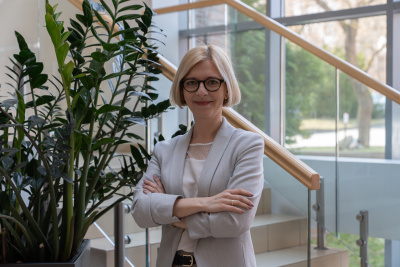
Urszula Abucewicz: Before you started teaching marketing at the Faculty of Management, you worked in the dean’s office for nearly 15 years.
Zuzanna Minga: Right after graduating in political science from the Faculty of Social Sciences, I began working in the dean’s office at the Faculty of Management. Initially, in 2009, I dealt with a very specific area—providing social support to students in difficult life situations.
I would sit with each student, help them, guide them through the process, explain what documents they needed to submit to receive financial aid. There were times when I was overwhelmed—up to 1,500 applications per semester. Each one represented a difficult personal story, uncertainty, and sometimes an inability to ask for help. My role was to support, explain, and assist—but also to verify and process everything carefully. I never approached those applications mechanically. It was a heavy workload—far too heavy at times.
Around that same period, I was diagnosed with endometriosis. My health was deteriorating, and surgery became inevitable. I didn’t give up, though. Today, I support women with this condition through the “Pokonać Endometriozę” Foundation and try to help my students facing the same challenges.
Let’s go back to your path at the University of Gdańsk. You were involved in more than just social support, right?
Yes, I was also involved in organizing Open Days and other events, supervising student organizations, collaborating with the student government, and working with the social committee. I was always close to students. When they came to see the dean, they often checked with me first—whether it was a good time or not. I became a bridge between students and the administration, sometimes walking a fine line and helping even outside office hours.
At that time, Dean Prof. Jerzy Bieliński closely observed my work. He often told me: “Ms. Minga, you are wasting your potential here.” He saw my creativity and organizational skills and encouraged me to pursue a second degree at the Faculty of Management. Eventually, I agreed. I completed a second master’s degree there, and ten years ago I defended my thesis. That’s when marketing became my passion.
I started implementing marketing solutions at the faculty—creating and developing its Facebook presence, learning content creation through trial and error, and tailoring communication to specific target groups.
Were you still handling social matters at that time?
My responsibilities evolved. I also managed international student affairs, especially Erasmus students. Since I speak English fluently, I felt very comfortable in an international environment and built many connections with foreign academics.
Then the faculty leadership changed.
Yes, Prof. Bieliński retired, and Prof. Mirosław Szreder became dean. He invited me to become his assistant. I was still responsible for promotion, but I also took on administrative and financial duties, such as processing invoices. I managed everything, but administrative work drained me.
As an assistant, I got to know the entire faculty—from support staff to students, vice-deans, and deans. However, what brought me the most satisfaction was marketing, PR, and building the faculty’s image.
I suppose I’m a bit of a “one-person orchestra.”
That sounds like the workload of two people. How did you manage it?
I have been diagnosed with ADHD. I didn’t know it back then, but perhaps it contributed to my creative way of handling all these tasks.
At some point, you decided to leave the dean’s office and start teaching.
Yes. I was constantly developing my skills in digital marketing and felt very much in my element. Then Prof. Szreder said to me: “You are wasting your potential here. Why don’t you pursue a PhD?” He also encouraged me to try teaching marketing classes. I decided to give it a chance—and started my doctoral research on senior consumer behavior.
You now teach Generation Z students. Some say they are demanding. Do you agree?
No—Generation Z fascinates me. They are not demanding; they simply set boundaries. My generation often prioritized hard work over personal life. Gen Z values work-life balance and asks practical questions: “What will I gain from this?”, “What skills will I acquire?”
They don’t want to memorize theory—they want practical knowledge. Teaching today must adapt to that.
How did you adjust your teaching methods?
At first, I struggled. Students were distracted, often on their phones. So I began experimenting with more engaging methods—especially gamification.
In my sports marketing classes, I introduced competition-based tasks. Students created products and pitched them to “investors.” It was a breakthrough. By the end of the semester, they were asking if they would have classes with me again.
You also developed your own educational game.
Yes, together with my colleague, we created Marketing Land. Students run their own marketing agencies and complete missions aligned with the syllabus. They learn by doing—often without even realizing it.
You also work with real businesses.
Exactly. Students analyze real restaurants and hotels with low ratings and redesign their strategies using design thinking. They visit these places, verify issues, and propose improvements. The results are often impressive.
What about other teaching methods?
We use the flipped classroom model. Students prepare and lead classes themselves. This builds confidence, creativity, and engagement.
We also organize study visits—to arenas, marketing agencies, and industry events—so students can experience real-world marketing.
You also studied students’ use of AI tools like ChatGPT.
Yes, we found that students are concerned about its impact on creativity. I teach them how to use AI responsibly—as a tool, not a replacement for thinking.
I emphasize: AI can generate ideas, but creativity must come from them. It can support writing, but not replace originality.
Do you trust AI?
With caution. It can be useful, but it can also generate false information. I always teach students to verify sources.
You received the Prof. Tadeusz Dmochowski Award. What does it mean to you?
It’s very special—especially because I was nominated by students, and Prof. Dmochowski was once my teacher. It’s both an honor and motivation.
You seem very close to your students.
I genuinely enjoy working with them. I support them whenever I can—even outside working hours. We stay in touch, share opportunities, and discuss trends.
How do you maintain balance?
When work is your passion, it feels different. But I do recharge—usually in nature. I live near a forest and love observing birds. It helps me relax and regain energy.
Final thoughts?
Marketing is my path. Teaching is my passion. And combining theory with practice allows me to give students something truly valuable.
Based on an article by Urszula Abucewicz (CKiP), University of Gdańsk
https://ug.edu.pl/news/pl/10093/marketing-moja-droga-rozmowa-z-zuzanna-minga
Photo: Bartłomiej Jętczak (CKiP)
Edited and translated by the Faculty of Management, University of Gdańsk